overview
sizing
traffic
demographics
methodologies
digital divides
jargon
sources
|
 demographics
This page highlights studies of who's online
and the value of online activity.
 who's online?
Figures for users of the Web are
problematical. One estimate
suggests that the number will grow to 707 million in 2002.
The US Department of Commerce (DOC)
and national Telecommunications & Information Administration (NTIA)
reports on Falling
Through The Net provides a detailed picture of who's online, analysing the
'telecommunications and information technology gap in America'. There's
a detailed consideration of the 'digital divide' later
in this guide.
The State of the Net 2000 report
is a snapshot by the US Internet Council (USIC) of
access, ecommerce, traffic and other Internet statistics. While some of
the figures are suspect, the report is a useful compilation. USIC's 1999
report
is also online.
The Computer Industry Almanac claims
that the US has over 110 million users in 1999 (43% of the global figure
of 259 users), with Australia just ahead of Brazil at 6.83 million
users. It projects 765 million users (ie around 10% of the population)
by 2005. All very eye of newt and foot of toad .... such estimates
are necessarily problematical.
In Australia the National Office for
the Information Economy (NOIE) and the
Australian Bureau of Statistics (ABS)
have released reports on who's online and
whether they'll be joined by other surfers in future.
The June 2000 NOIE-Yellow
Pages report
offers figures, somewhat contentious, about use of the web by small,
medium and large-scale enterprises. Much
of that
report
is inconsistent with the more credible
December 2000 report from the Australian Bureau of
Statistics (ABS)
regarding business use of IT, including use of email,
etailing and online presences.
The May 2000 figures
from the ABS claimed that 54% (3.8 million) of Australian homes have a
computer; 51% of regional homes have a machine, a 21% increase in three
months, and nationally a third of Australian homes "have Internet
access". 46% of all adults accessed the web in the preceding 12
months.
As noted in our guide to the Web, Paul Clemente's
The State of the
Net (New York, McGraw-Hill 98) almost by default has become a
standard source in the industry, despite controversy over alleged
appropriation of academic research.
where are the dollars?
Research into the economic size of the Web featured at the 1999
US conference
on Understanding
The Digital Economy: Data, Tools & Research mentioned above.
We recommend the papers by Haltiwanger and Varian in particular. Our
economy guide discusses particular issues in more detail
and concludes with detailed statistical references.
Material at the Vanderbilt Uni eLab
site is also of value. At a global level the OECD's 1997 report
on Measuring Electronic Commerce remains of value.
Measuring the Internet Economy, the October 1999 report by the
University of Texas and Cisco, is decidedly upbeat but worth examination
for economic projections. It's available at the Internet
Indicators site.
Lada Adamic & Bernardo Huberman in their May 1999
paper
The
Nature of Markets in the World Wide Web - based on an
examination of 120,000 sites - argue that statistics for visits to sites are
characteristic of a winner-take-all market.
Whether that will remain the
case in future is unclear; we believe that effective marketing online and
offline will offset disadvantages faced by many Australian sites who
aren't 'winning' the traffic.
and the languages
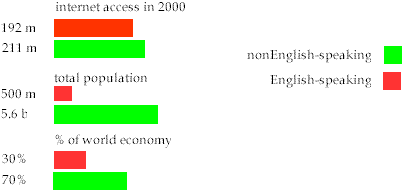
GlobalReach, an internet marketing company, has published
figures on the languages used by those online. Those
figures are of course disputed and are inconsistent with
some of the data featured on this page. They suggest that
 next page
(methodologies)
next page
(methodologies)
|

