overview
sizing
traffic
demographics
methodologies
digital divides
jargon
resources
|
 sizing the web:
domains, sites, pages
sizing the web:
domains, sites, pages
This page examines the size and shape of the
Web: estimates of the number of domains, pages and users.
Identification of the total
number of sites on the Web is problematical. Figures about domains are
more certain than figures on the number of pages, the number of links or
the number of viewers.
The implications of those figures are even more
problematical, as Andrew Odlyzko notes in a cogent paper
on Internet Growth: Myth & Reality, Use & Abuse
in the November 2000 issue of Information Impacts
magazine.
 domains and servers
As of 10 June 2000 one global figure for registered
domains is 17.75 million, including 9.48 million dot com domains.
Those figures come from the DomainStats
site.
Netcraft argues
that there are over 15 million domains, with slower growth of
registrations in 2000 (around 10% per month) and the disappearance of 330,000
domains.
The January 2000 Domain Survey by the Internet Software
Consortium (ISC) suggests
that there are upwards of 88 million hosts on the Internet.
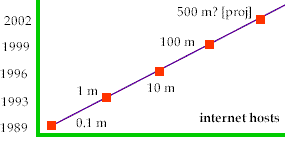
The OECD believes
that there are around 52 thousand secure servers - tools for electronic
commerce - in the USA, and upwards of 74 thousand in the OECD as a whole
(a growth of 95% over the preceding year).
where is the
growth occurring?
The Mosaic Group at the University of
Omaha has a project on
Global Diffusion of the Internet, measuring growth of the net on a
global and nation by nation basis.
The Internet Geography Project
(IGP)
at the University of California, under Matthew Zook, offers
authoritative maps and a number of excellent papers.
The UN Development Program
1999 Human Development Report (HDR)
includes statistics about internet diffusion in the third
and fourth worlds.
number of pages and documents
The latest academic estimate from the US is that
the Web has some 800
million pages - this page is 800 million plus one - with Northern
Lights, the most inclusive search engine, covering less than 16% of that
figure.
Three of the seminal papers - often referred to as the 'NEC
studies' - are How
Big is the Web (HBW),
Accessibility
& Distribution of Information on the Web (ADIW)
and the 1998 and 1999 Search
Engine Coverage Update (SECU)
by Steve Lawrence & C Lee Giles. The
most recent paper suggests that the Web is growing faster than coverage
by the search engines and that dead links are more common.
Inktomi
and NEC Research earlier this year estimated
that there were more than a billion "unique pages".
Wallace
Koehler's paper
on Digital Libraries & WWW Persistence estimates that the
'half life' of a web page is less than two years and the half life of a
site is a bit more than two years. We've highlighted some of the
consequences for information retrieval in our Connecting
guide.
US
metrics company Cyveillance estimates
that there are over 2.1 billion pages on the web (heading towards 4
billion by the end of 2001) with the "average page" having 23
internal links, 6 external links and 14 images.
BrightPlanet, a new entrant to the
search engine market, claims
that "the deep Web" contains "550 billion individual
documents", with only a small fraction indexed by its competitors.
That figure, like many web statistics, is problematical.
More importantly, unlike the 'surface web' the deep web information is generally not
publicly accessible, eg involves a subscription or item
fee or resides on a corporate intranet. That's one
reason for concern about digital divides. It's also a
reason why academic/public libraries have an ongoing role.
The major study
by Hal Varian & Peter
Lyman on scoping the 'information universe' - quantifying what's
produced, transmitted, consumed and archived - is of relevance.
 next page
(traffic)
next page
(traffic)
|

