overview
sizing
traffic
demographics
methodologies
digital divides
jargon
resources
|
 traffic
This page examines
traffic flows.
 traffic maps and directions
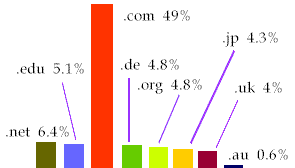
The 'US' domains (ie .com, .net, .org and .edu) continue
to account for more than half of destinations, as this
schematic suggests:
The Geography
of Cyberspace project supplies extensive maps and diagrams that represent Internet
traffic, the geographical distribution of hosts and other features of
cyberspace. It also offers a useful bibliography.
We'll shortly be giving you some pointers to
the direction of traffic and growth patterns. For the moment why not
explore the Hoffman
& Novak research from Vanderbilt Uni about the Web in 1995, the
links on Hal Varian's
site and Matthew Zook's 1998 paper
on The
Web of Consumption: The Spatial Organization of the Internet Industry in
the US for maps of Internet traffic, the geographical
distribution of hosts and other features of cyberspace?
Netgraphs
provides pointers for statistics buffs. The Cooperative
Association for Internet Data Analysis (CAIDA) has a large range
of papers and reports on bandwidth, transfer pricing and the nitty
gritty of traffic between telcos and ISPs.
Martin Dodge, leading
cybergeographer, has an excellent introduction
to mapping traffic and co-authored the outstanding Mapping Cyberspace
(London, Routledge 2000), which has a companion site.
The Electronic Space Project (Espace)
at Michigan State University complements the Geography project. We
recommend Information Tectonics: Space, Place & Technology In An
Electronic Age (New York, Wiley 00) a collection of papers edited by
Mark Wilson & Kenneth Corey and the associated maps
of hosts and access to telecommunications.
Matthew Zook's 1998 paper
The Web of Consumption: The Spatial Organization of the Internet
Industry in the US provides a striking demonstration of how the
supposedly 'spaceless' Internet industry is clustering in specific
geographical locations, in particular New York, LA and San Francisco. It
is complemented by NY University's project
on information technology and the future of the urban
environment, in particular the mapping.
Zook's mapping should not be a surprise
to anyone who's considered the location of the major newspapers,
broadcasters and publishers, though there's a more elaborate analysis in
Tendencies & Tensions of the Information Age: The Production
& Distribution of Information in the United States (New
Brunswick, Transaction 97) by Jorge Schement & Terry Curtis,
building on Fritz Machlup's pathbreaking Knowledge, Its Creation,
Distribution & Economic Significance (Princeton, Princeton Uni
Press 84).
If price is not a consideration consult TeleGeography
200 - Hubs & Spokes: A telegeography internet reader (Washington,
Telegeography 00) is a detailed report the consultancy of
the same name.
 next page
(demographics)
next page
(demographics)
|

