overview
issues
primers
engineering
addressing
infrastructure
traffic
Australia
advocacy
convergence
broadband
wireless
|
 Traffic and Access
This page is under construction.
The information economy is built around low cost
instantaneous global communications: the ability to easily
send and receive data (statistics, prose, video,
multimedia). Overall, the cost of pumping bits around the
country - and around the globe - has fallen dramatically
over the past three decades, in conjunction with increased
traffic flows.
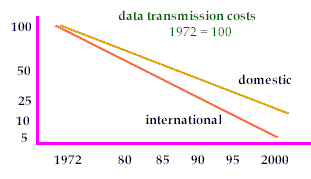
Local and international data transmission costs declined by up to three orders of
magnitude over the past two decades.
Price
declines for most consumers have not been that dramatic
and contrary to George Gilder's prophecies in the
millenarian Telecosm:
How Infinite Bandwidth Will Revolutionise Our World
(New York, Free Press 00)
the cost of being online - and who pays - remains a
significant issue.
 economics
For a basic introduction to network economics we
recommend Internet Economics (Cambridge, MIT Press 00),
edited by Lee McKnight & Joseph Bailey.
Composition
Estimates of the composition of internet traffic are
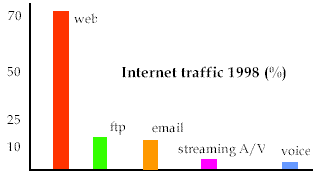
problematical. As of 1998 it is likely that access to web
pages accounted for around 70% of the traffic, with
electronic mail and file transfer (ftp) at around 10%.
Streaming video/audio and voice (internet telephony) have
not shown the growth forecast by some analysts, for
reasons that include traffic costs, low demand for much of
the content (watching television or wet paint is more
entertaining than much streamed content) and disagreement
about standards resulting in limited uptake of proprietary
technologies.
Traffic Flows
The
metrics guide on this site
points to studies - and some stunning maps -
about internet traffic flows: who's online, where they
reside, the volume of traffic, the growth of sites (and
pages).Australia is a net importer of internet content
(consistent with its status as a importer of content
offline, ie books, magazines, film, sound recordings). As
a result the existing international traffic charging
regimes - biased towards exporters - are of concern.
Closer to home debate continues about local varieties of
the digital divide. Sociodemographic
Barriers to Telecommunications Use, a major new report
for Telstra, argues that the Australian 'digital divide'
is one of income and social situation, not geography -
questioning the government's concern with supply to rural
areas.
We'll be adding
other pointers shortly.
 next
page
(Australia)
next
page
(Australia)
|

