about
recent work
case studies
affiliations
contact
logo
|
 the artist
Born in Augsburg in 1473, Hans Burgkmair studied under Martin Schongauer in Kolmar.
He became a
member of the painters' guild in Strasbourg in 1490 and in Augsburg in
1498.
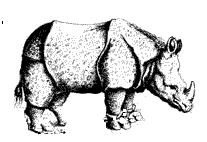
He's believed to have studied in Italy (1507?) - where he may have
sighted elephants and rhinos given to the Pope - before returning home
to one of the technological and financial centres of Europe.
Augsburg
was momentarily the centre of the printing revolution: Johannes Gutenberg,
in nearby Mainz, had earlier gone bust through bad management and
competition. It housed
contemporary 'high tech' metal industries (including first mass
production of the screw) and handled finances for an
empire that stretched across much of Europe and South America. It also
had a reputation for advanced thinking and wild living: Dr Faustus was
supposedly another local and alchemist Paracelsus visited Maximilian's
court.
All in all, an interesting place to work:
analogous to a mix of New York and Silicon Valley in the 1990s.
Like
contemporaries such as Durer and Altdorfer, Burgkmair sought commissions
from the noble, the church and the merely well-to-do. He decorated
residences in Munich and other parts of southern Germany.
One notable project was his frescoes for the palatial townhouse of imperial
moneyman Jakob Fugger - a proto venture capitalist of the 1500s. It was the first italianate renaissance palace in Germany. He
painted a number of oils on religious subjects. His portraiture's
considered by some to have influenced Hans Holbein the Younger and
Albrecht Altdorfer.
 woodcuts for the rich & infamous
Burgkmair's
career - then and now - was overshadowed by Albrecht Durer. He is chiefly famous for his woodcuts, at that time a fairly new form that had
become prominent through increased availability of paper - the bandwidth
of the period - and through the inclusion of
prints in the new books.
He's known to
have produced around 700 woodcuts, including works that are considered
of significance because they're in colour or because they demonstrate
mastery of light and shade. Examples are available on the web (eg 1,
2, 3,
4),
along with a 1517 self
portrait.
Burgkmair
contributed to a large-scale series of woodcuts - The Triumph of
Maximilian (1512-26) - intended to glorify Holy Roman
Emperor Maximilian I, one of the more forgettable emperors despite his
eagerness to claim Julius Caesar, Alexander the Great and Hercules among
his ancestors.
To celebrate his wedding - which alas didn't last
long - the emperor commissioned a celebration built around a vast
procession modelled on the triumphal parades of classical Rome. The
event made a serious dint in the imperial budget; unsurprisingly the
Fugger family went bust some years later - a precursor of the Y2K dot
com crash - when the emperor's successors didn't repay major borrowings.
Burgkmair was a
leading participant in production of 137 woodcuts - 57 metres in length
- depicting Emperor Max's triumphal procession. Albrecht
Durer's studio produced a monster print, measuring 3.5 metres by 3
metres, of the Emperor's triumphal arch. Investment in golden trumpets,
silken banners, ponies and poodles apparently meant that imperial finances didn't
stretch to a stone arch; they made do with a temporary plaster &
timber structure that was immortalised by Durer.
Energetic
spin-doctoring was apparently unsuccessful, as the Emperor was nearly
deposed in 1500.
Burgkmair
also illustrated Maximilian's writings such as the allegorical novel The
White King and Theuerdank.
His oil paintings
and frescos are found in collections in Europe and North America. While there are
apparently no Burgkmair paintings in Australia, institutions such as the
National Gallery of Victoria hold his prints.
|

